
California criminal procedure outlines the legal steps the state follows when someone is accused of a crime. Unlike civil cases, which involve disputes between individuals or organizations, criminal cases are brought by the state of California against a person or entity suspected of violating criminal law. The process begins with an investigation, often triggered by a police report, and can lead to charges ranging from infractions to misdemeanors or felonies. Each type of charge carries different consequences, with infractions typically resulting in fines, while misdemeanors and felonies may involve jail time, probation, or prison sentences. The state must prove guilt beyond a reasonable doubt, and the accused has constitutional rights throughout the process, including the right to remain silent, the right to an attorney, and the right to a fair trial.
The criminal procedure in California is governed by the California Penal Code, the California Constitution, and court rules established by the Judicial Council. These laws ensure that every person accused of a crime is treated fairly and has the opportunity to defend themselves. The process includes specific stages such as arrest, arraignment, preliminary hearing, discovery, trial, sentencing, and appeals. Each stage has strict timelines and procedural requirements. For example, a suspect must be brought before a judge within 48 hours of arrest unless it falls on a weekend or holiday. The system is designed to balance public safety with individual rights, ensuring that no one is punished without due process. Knowing how this system works is essential for anyone involved in a criminal case, whether as a defendant, victim, or legal professional.
Stages of a California Criminal Case
The criminal case process in California follows a structured sequence of events, each with specific legal requirements and timelines. Missing a deadline or misunderstanding a step can have serious consequences. The process begins with law enforcement involvement and ends with sentencing or appeal. Each stage builds on the previous one, and decisions made early can affect the outcome of the entire case. Below are the key stages, broken down into detailed subsections.
Arrest and Booking
An arrest occurs when a law enforcement officer takes a person into custody based on probable cause that a crime has been committed. In California, officers must have a valid warrant for a felony arrest unless the crime was committed in their presence or there are exigent circumstances. For misdemeanors, an arrest without a warrant is allowed only if the officer witnesses the crime. After arrest, the suspect is taken to a police station or jail for booking.
- Booking Process: Includes fingerprinting, photographing, recording personal information, and inventorying personal belongings.
- Initial Appearance: Must occur within 48 hours of arrest (excluding weekends and holidays). A judge informs the defendant of the charges and appoints a public defender if the person cannot afford an attorney.
- Bail Hearing: The judge decides whether to release the defendant on bail, set conditions for release, or hold the person in custody.
Arraignment
The arraignment is the defendant’s first court appearance, where formal charges are read. The defendant is asked to enter a plea: guilty, not guilty, or no contest. If the plea is not guilty, the case moves forward. If guilty or no contest, the judge schedules sentencing. The arraignment must occur within a few days of the initial appearance, depending on the charge.
- The judge confirms the defendant’s identity and right to counsel.
- The charges are read aloud or provided in writing.
- The defendant enters a plea.
- The judge sets bail or release conditions if not already done.
- A future court date is scheduled.
Preliminary Hearing
In felony cases, a preliminary hearing is held to determine if there is enough evidence to justify a trial. This hearing occurs in front of a judge, not a jury. The prosecution presents evidence, and the defense can cross-examine witnesses. The judge decides whether the case should proceed to trial.
- Purpose: To establish probable cause that a crime was committed and that the defendant committed it.
- Defense Role: Can challenge evidence and testimony but cannot present a full defense.
- Outcome: If probable cause is found, the case is “bound over” for trial. If not, charges may be reduced or dismissed.
Searching California Criminal Case Records
California provides public access to criminal case information through official court systems. These records may include case numbers, charges, court events, and case outcomes.
- To access California court services, use the official California Courts website:
- https://www.courts.ca.gov/
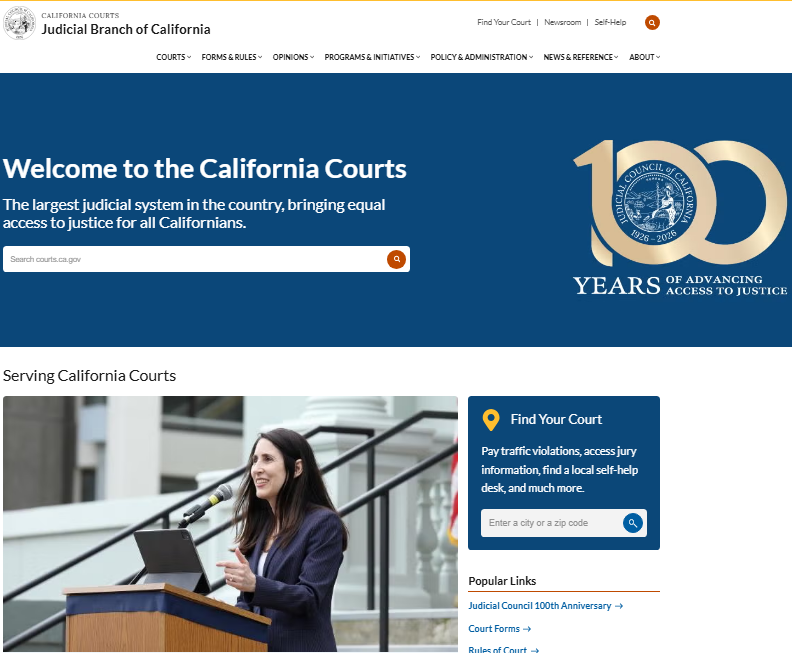
- From there, users can navigate to:
Public Access / Case Information / Online Services → Select County Court
Online Case Search Process
The California Courts system connects users to individual county court databases, where case searches are performed.
Steps:
- The https://www.courts.ca.gov/
- Navigate to Online Services or Case Information
- Select the appropriate county Superior Court
- Open the Case Search tool
- Enter:
- Defendant’s full name, or
- Case number
- Click Search
Search Results May Include
- Defendant name
- Case number
- Filing date
- Criminal charges
- Court hearings and schedules
- Case disposition
Types of Criminal Charges in California
California classifies crimes into three main categories: infractions, misdemeanors, and felonies. Each category has different penalties, procedures, and long-term consequences. The classification affects everything from arrest procedures to sentencing options. Understanding the differences is crucial for anyone facing charges or working within the criminal justice system.
Infractions
Infractions are the least serious offenses and are not considered crimes in the traditional sense. They typically involve violations of local ordinances or minor state laws, such as traffic tickets or littering. No jail time is involved, and the maximum penalty is a fine.
- Examples: Speeding, jaywalking, illegal parking.
- Penalties: Fines up to $250, no jail time.
- Legal Representation: Not required, but defendants can hire an attorney.
- Record Impact: Infractions do not appear on criminal background checks unless unpaid fines lead to a civil judgment.
Misdemeanors
Misdemeanors are more serious than infractions and can result in jail time, fines, or probation. They are punishable by up to one year in county jail. Common misdemeanors include petty theft, simple assault, and first-time DUI offenses.
- Common Charges: Shoplifting, trespassing, disorderly conduct.
- Sentencing: Up to 364 days in county jail, fines up to $1,000, or both.
- Expungement: Possible under Penal Code 1203.4 if probation is completed.
- Right to Jury Trial: Yes, but often waived in favor of a bench trial.
Felonies
Felonies are the most serious criminal charges and can result in prison time, large fines, and long-term consequences such as loss of voting rights or firearm ownership. Felonies are punishable by more than one year in state prison. Some felonies are “wobblers,” meaning they can be charged as either a misdemeanor or a felony depending on the circumstances.
| Felony Type | Example | Maximum Penalty |
| Straight Felony | Murder, rape | State prison: 3 years to life |
| Wobbler | Grand theft, assault with a deadly weapon | County jail (misdemeanor) or state prison (felony) |
| Three Strikes | Third serious/violent felony | 25 years to life |
California Criminal Trial Process
The trial is the central stage where the prosecution and defense present evidence to determine guilt or innocence. In California, the defendant has the right to a trial by jury or by a judge alone. Most felony cases are tried before a jury of 12 people, while misdemeanors may use a smaller jury or a bench trial. The trial follows strict rules of evidence and procedure to ensure fairness.
Jury Selection (Voir Dire)
Jury selection is the process of choosing impartial jurors from a pool of citizens. Both the prosecution and defense can question potential jurors and dismiss some without cause. The goal is to select a jury that can fairly evaluate the evidence.
- Process: Jurors fill out questionnaires, then are questioned in court.
- Challenges: Each side can use peremptory challenges (limited number) or challenges for cause (unlimited if bias is shown).
- Outcome: 12 jurors (plus alternates) are selected for felony trials.
Opening Statements
After jury selection, both sides give opening statements. These are not evidence but outlines of what each side plans to prove. The prosecution goes first, followed by the defense. The judge may limit the length and content.
- Prosecution: Explains the charges and summarizes expected evidence.
- Defense: May present a theory of the case or highlight weaknesses in the prosecution’s evidence.
- Rules: No arguments, personal opinions, or evidence not yet presented.
Presentation of Evidence
The prosecution presents its case first, calling witnesses and introducing physical evidence. The defense can cross-examine each witness. After the prosecution rests, the defense may present its case, though it is not required. The defense can also challenge the prosecution’s evidence through motions to suppress.
- Burden of Proof: Prosecution must prove guilt beyond a reasonable doubt.
- Evidence Rules: Hearsay, irrelevant, or prejudicial evidence may be excluded.
- Expert Witnesses: Allowed to explain technical or scientific evidence.
Sentencing and Appeals in California
After a guilty verdict or plea, the judge imposes a sentence. Sentencing options vary based on the crime, criminal history, and mitigating or aggravating factors. In some cases, the defendant can appeal the conviction or sentence. Appeals are not retrials but reviews of legal errors during the trial.
Sentencing Options
Judges have discretion in sentencing but must follow state guidelines. Options include jail or prison time, probation, fines, restitution, community service, or diversion programs. For first-time offenders, alternatives to incarceration are often available.
| Option | Description | Eligibility |
| Probation | Supervised release instead of jail | Non-violent offenses, first-time offenders |
| Split Sentence | Part jail, part probation | Mid-level misdemeanors and felonies |
| Work Furlough | Serve time in a work-release facility | Non-violent, employed defendants |
| Felony Diversion | Charges dismissed after completing program | First-time, low-level felony offenders |
Appeals Process
A defendant can appeal a conviction or sentence to a higher court. The appeal must be based on legal errors, such as improper jury instructions, admission of illegal evidence, or ineffective assistance of counsel. The appellate court reviews the trial record but does not hear new evidence.
- Notice of Appeal: Must be filed within 60 days of sentencing.
- Appellate Brief: Written argument explaining the legal errors.
- Oral Argument: An optional hearing where attorneys speak to the judges.
- Decision: The court can affirm, reverse, or remand the case.
Post-Conviction Relief
In addition to appeals, defendants can seek post-conviction relief through habeas corpus petitions or motions for a new trial. These are used when new evidence is discovered or constitutional rights were violated. Habeas corpus petitions are filed in state or federal court and require strong evidence of innocence or legal error.
- Habeas Corpus: Challenges unlawful detention based on constitutional violations.
- Motion for New Trial: Filed within 15 days of verdict, based on new evidence or misconduct.
- Expungement: Under Penal Code 1203.4, it clears a conviction from the record if probation was completed.
California Criminal Defense Rights
Every person accused of a crime in California has specific constitutional and statutory rights. These rights protect against unfair treatment and ensure a fair legal process. Knowing these rights is essential for defendants and their attorneys.
Miranda Rights
Miranda rights must be read to a suspect before custodial interrogation. These include the right to remain silent, the right to an attorney, and the warning that anything said can be used in court. If Miranda is not properly administered, statements made may be excluded from evidence.
- When Required: During arrest and before questioning.
- Waiver: Must be knowing, intelligent, and voluntary.
- Consequences: Un-Mirandized statements may be suppressed.
Right to Counsel
The Sixth Amendment guarantees the right to an attorney. If a defendant cannot afford one, the court must appoint a public defender. This right applies at all critical stages, including interrogation, lineup, arraignment, and trial.
- Appointment: Made at the first court appearance.
- Private Attorney: Can be hired at any time.
- Self-Representation: Allowed but not recommended.
Protection Against Unreasonable Search and Seizure
The Fourth Amendment protects against unreasonable searches and seizures. Evidence obtained without a valid warrant or exception may be suppressed under the exclusionary rule. Common exceptions include consent, plain view, and exigent circumstances.
- Warrant Requirement: Generally needed for home searches.
- Exceptions: Stop and frisk, vehicle searches, emergencies.
- Suppression Motion: Filed before trial to exclude illegal evidence.
California Criminal Procedure Forms and Motions
Legal forms and motions are essential tools in criminal defense. They allow attorneys and defendants to request court action, challenge evidence, or assert rights. Using the correct form and filing it on time is critical.
Common Criminal Motions
Motions are written requests to the court asking for a specific ruling. They must be filed before or during trial and include legal arguments and supporting evidence.
- Motion to Suppress: Challenges illegally obtained evidence.
- Motion to Dismiss: Argues insufficient evidence or legal defects.
- Motion for Discovery: Requests evidence from the prosecution.
- Motion for Continuance: Asks to delay a court date.
Required Forms
Each motion requires a specific form, often available on the Judicial Council website. Forms must be completed accurately and filed with the court clerk.
- Form CR-110: Notice of Motion and Motion.
- Form CR-115: Memorandum of Points and Authorities.
- Form CR-120: Proof of Service.
Filing Procedures
Motions must be filed in the correct court, served on the opposing party, and scheduled for a hearing. Deadlines vary by case type and court rules.
| Step | Action |
| 1 | Complete the motion form and attach supporting documents. |
| 2 | File with the court clerk and pay any required fee. |
| 3 | Serve a copy on the prosecutor by mail or personal delivery. |
| 4 | File proof of service with the court. |
| 5 | Attend the scheduled hearing. |
California Criminal Law Resources
Staying informed about California criminal law requires access to reliable legal resources. These include official codes, court rules, case law, and government websites.
Primary Legal Sources
The foundation of California criminal law is the Penal Code, which defines crimes and punishments. Other key sources include the Constitution, court rules, and published appellate decisions.
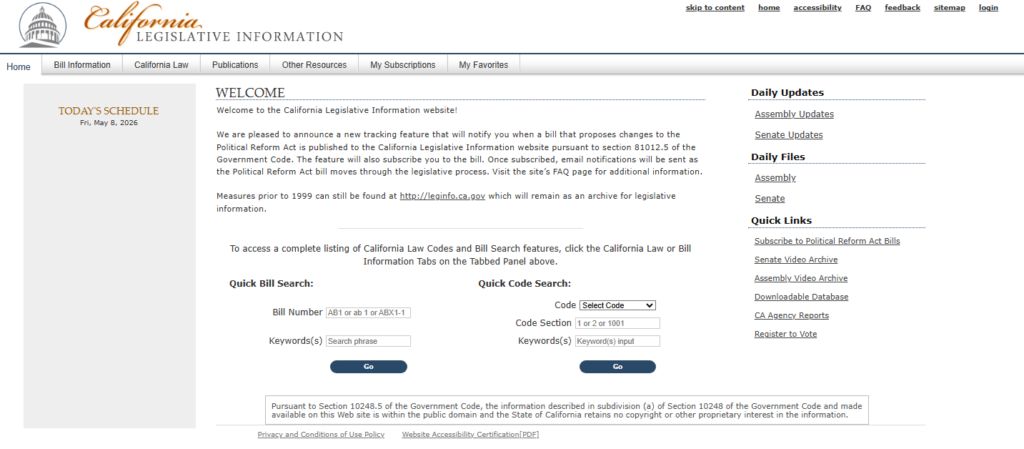
- California Penal Code: Available at leginfo.legislature.ca.gov
- California Rules of Court: Found at www.courts.ca.gov/
- Case Law: Searchable through Justia or CourtListener
Government and Legal Aid Sites
Several organizations provide free legal information and assistance to the public.
- California Courts Self-Help Center: www.courts.ca.gov/
- Public Defender Offices: Offer legal representation and resources.
- Legal Aid Societies: Provide free services to low-income individuals.
Continuing Legal Education
Attorneys must complete continuing education to stay licensed. Programs cover updates in criminal law, procedure, and ethics.
- State Bar of California: Offers CLE courses and requirements.
- Local Bar Associations: Host seminars and workshops.
- Online Platforms: Include https://www.lexisnexis.com/en-us/gateway.page and Westlaw https://www.westlaw.com for legal research.
| Address | California Courts Administrative Office 455 Golden Gate Avenue, San Francisco, CA 94102 |
| Phone | (415) 865-7000 |
| Hours | Monday–Friday, 8:00 AM – 5:00 PM (Pacific Time) |
Frequently Asked Questions
This section provides clear answers to some of the most common questions related to California criminal law and court procedures. It is designed to help individuals understand their rights, legal processes, and what to expect at different stages of a criminal case.
What happens if I am arrested in California without a warrant?
In California, an arrest without a warrant is legal only under specific conditions. For felonies, officers must have probable cause and either witness the crime or face exigent circumstances, such as a suspect fleeing. For misdemeanors, an arrest without a warrant is allowed only if the officer sees the crime happen. After arrest, you must be brought before a judge within 48 hours. During this initial appearance, the judge informs you of the charges, appoints an attorney if needed, and sets bail. If the arrest was unlawful, your attorney can file a motion to suppress any evidence obtained as a result. However, the arrest itself does not automatically dismiss the case. The legality of the arrest is just one factor the court considers.
Can I represent myself in a California criminal trial?
Yes, you have the constitutional right to represent yourself, known as proceeding “pro se.” However, this is strongly discouraged, especially in felony cases. Criminal law is complex, and judges and prosecutors are not required to assist self-represented defendants. You must follow all court rules, file motions correctly, and understand evidence procedures. If you choose to represent yourself, the court may still appoint an advisory attorney to answer questions. Mistakes in procedure or law can lead to conviction, even if you are innocent. Most defendants who represent themselves receive harsher sentences than those with attorneys. Public defenders are experienced in California criminal law and can provide strong defense strategies.
How long does a felony case take in California?
The timeline for a felony case in California varies based on complexity, court workload, and plea negotiations. Generally, a felony case takes 6 to 18 months from arrest to resolution. After arrest, the preliminary hearing must occur within 10 court days if the defendant is in custody. If released on bail, the hearing is within 15 court days. Arraignment happens within a few days of the initial appearance. Discovery and pre-trial motions can add months. If the case goes to trial, jury selection and trial may take several weeks. Many cases end in plea bargains before trial, which speeds up the process. Delays can occur due to continuances, evidence issues, or backlogged courts.
What is the difference between a misdemeanor and a felony in California?
Misdemeanors and felonies differ in severity, penalties, and long-term consequences. Misdemeanors are punishable by up to one year in county jail, fines up to $1,000, or both. Examples include petty theft, simple assault, and first-time DUI. Felonies carry prison sentences of more than one year, higher fines, and lasting impacts like loss of gun rights or voting rights. Some felonies are “wobblers,” meaning they can be charged as either a misdemeanor or a felony based on the defendant’s record and circumstances. Felony convictions also make expungement more difficult and affect employment, housing, and professional licenses. The classification affects bail, trial procedures, and sentencing options.
How do I get a criminal record expunged in California?
Expungement under Penal Code 1203.4 allows you to withdraw your guilty or no contest plea and dismiss the case. To qualify, you must have completed probation, not be currently charged with a crime, and not be serving a sentence. The process starts by filing a petition with the court that handled your case. You must pay a filing fee unless you qualify for a fee waiver. The court schedules a hearing, and the prosecutor may object. If granted, the conviction is set aside, and you can legally state you were not convicted. However, the record is not destroyed and may still appear on background checks for certain jobs, such as law enforcement. Expungement does not restore gun rights or remove sex offender registration.